Stem-Cell-Cytokine Biology and Hair Regeneration: A Physician's Guide
Hair growth is one of the most actively studied areas of regenerative biology, and the science has advanced more in the past two decades than in the preceding century. At the center of that progress is a single idea that changes how physicians think about hair care: the hair follicle is not a passive structure that grows or doesn’t — it is a miniature regenerative organ, governed by a small population of resident stem cells, listening constantly for chemical signals from its surrounding environment. This article is a physician’s guide to that biology, and to why the “stem-cell-cytokine signaling” approach is the conceptual foundation of the modern MD Hair™ system.
Quick Answer
The hair follicle is a regenerative organ governed by a small population of hair follicle stem cells (HFSCs) in the bulge region, coordinated by a structure called the dermal papilla, and regulated by a network of cytokines and growth factors — chemical messengers including FGF, IGF, VEGF, KGF, and members of the Wnt and BMP families. Each new growth cycle (anagen) begins when these chemical signals shift the bulge stem cells from quiescence to activation. Modern topical hair care that mimics or supports this signaling environment — the “cytokine-signaling” approach — is the science behind the MD Hair™ Follicle Energizer. The approach is drug-free and was first described by Dr. Susan Lin in her 2013 publication in The Link — The Voice of the American Hair Loss Council.
Why Stem Cell Biology Matters for Hair
For most of the twentieth century, hair loss treatment was a binary choice: either suppress the hormonal pathway driving thinning (finasteride) or pharmacologically open blood vessels around the follicle (minoxidil). Both work for a subset of patients. Neither addresses the underlying biology of the follicle itself.
The shift that began in the 1990s and accelerated through the 2000s was the recognition that the hair follicle — like skin, blood, and intestine — is one of the body’s actively regenerating tissues. Every follicle on your scalp cycles through growth, regression, and rest continuously for decades. That cycling is not a default behavior; it is an active, governed process. And the agent in charge is a small population of resident stem cells.
Understanding that fact changes the whole question. The right question is no longer just “how do we stop the loss?” It is also: “how do we support the regenerative biology of the follicle itself?”
The Hair Follicle Stem Cell: Anatomy
If you were to look at a vertical cross-section of a hair follicle under a microscope, you would see a narrow tube extending from the scalp surface down into the dermis, ending in a bulb-shaped structure at the base. Roughly two-thirds of the way down that tube, just below where the sebaceous gland enters, there is a slight bulge in the outer root sheath. That bulge is the anatomical home of the hair follicle stem cells (HFSCs), sometimes called bulge stem cells.
These cells share three properties that mark them as stem cells in the strict biological sense:
- Self-renewal — they can divide and produce more of themselves without losing their stem-cell identity
- Multipotency — they can give rise to several specialized cell types, including the cells of the hair shaft and the cells of the surrounding outer root sheath
- Quiescence — the majority of bulge stem cells spend most of their time in a slow, resting state, only entering active division when the right signals arrive
That last property — quiescence — is what makes the system both elegant and vulnerable. A stem cell that is always dividing wears out. A stem cell that is held in reserve, awakened only when needed, can sustain decades of cycles. But it also means the system depends on the right activating signals arriving at the right time. When those signals are diminished — by age, stress, hormonal change, nutritional deficiency, or inflammation — the cycle slows, and the visible result is thinning.
The Dermal Papilla: The Master Conductor
If the bulge stem cells are the orchestra, the dermal papilla is the conductor. The dermal papilla is a small cluster of specialized fibroblasts that sit at the very base of the follicle, just beneath the matrix cells that build the hair shaft. The papilla is responsible for the size, shape, and pigmentation of the hair that the follicle produces, and it is the source of most of the chemical signals that tell the bulge stem cells when to activate.
Two findings about the dermal papilla have changed how we think about hair care. The first is that papilla cells lose their inductive signaling capacity when cultured under standard conditions — they need their three-dimensional structure and their neighboring cells to function. The second is that papilla cells shrink in androgenetic and age-related hair thinning. Smaller papilla, smaller signaling output, smaller hairs.
This is the biological reason that scalp-and-follicle-targeted topical care — supporting the dermal-papilla-and-bulge environment — is a distinct strategy from suppressing a single hormonal pathway. Both can have a place. They address different parts of the same system.
Cytokines and Growth Factors: The Chemical Messengers
The signals exchanged between the dermal papilla, the bulge stem cells, and the surrounding tissue are not vague. They are specific protein molecules — cytokines and growth factors — each with documented roles in either activating or suppressing hair cycle entry.
The cast is large, but a few molecules dominate the modern conversation:
- FGF (Fibroblast Growth Factor) family — particularly FGF-7 and FGF-10, which support anagen entry and follicle elongation
- IGF-1 (Insulin-like Growth Factor 1) — promotes follicle maturation and protects against premature catagen entry
- VEGF (Vascular Endothelial Growth Factor) — expands the capillary network around the follicle, supporting nutrient delivery during anagen
- KGF (Keratinocyte Growth Factor) — supports the matrix cells that physically build the hair shaft
- Wnt-pathway ligands — central activators of bulge stem cell entry into the cycle; deficient Wnt signaling is one of the molecular signatures of age-related thinning
- BMPs (Bone Morphogenetic Proteins) — counterbalancing signals that maintain quiescence; the right BMP/Wnt balance determines whether the system rests or activates
- TGF-β family — mixed roles; can promote catagen entry but also contributes to tissue remodeling during the cycle
The takeaway from a physician’s perspective is that hair growth is not controlled by a single molecule. It is controlled by a balance of activating and inhibiting cytokines, exchanged between the papilla, the bulge, and the surrounding tissue. Anything that tilts that balance — favorably or unfavorably — affects the cycle.
The Hair Growth Cycle Through a Stem Cell Lens
The classical description of the hair cycle — anagen (growth), catagen (regression), telogen (rest), and exogen (shedding) — takes on new meaning when viewed through the lens of stem cell biology.
The end of telogen and the beginning of a new anagen is not a passive timer running out. It is a coordinated event: the bulge stem cells, held in quiescence for weeks or months, receive a Wnt-dominant signal from the dermal papilla and begin to divide. Their daughter cells migrate down into the follicle, become matrix cells, and start building the next hair shaft. The capillary bed around the follicle expands under VEGF signaling. FGF and IGF reinforce the activation. The follicle elongates. A new hair grows.
When the activating signals are robust and the inhibiting signals are balanced, this transition happens reliably. When the signaling environment is degraded — smaller papilla, lower Wnt tone, higher BMP dominance — the transition stutters or fails. The bulge stem cells are still there, but they are not being told to act.
The Cytokine-Signaling Approach in Modern Hair Care
This is where modern hair care diverges from twentieth-century pharmacology. Instead of asking the question, “what drug should we deliver to suppress a hormonal pathway?”, the cytokine-signaling approach asks, “what topical agents can we apply that support the chemical signaling environment of the follicle?”
Several categories of actives have emerged:
- Peptide signaling fragments — short peptide sequences that mimic active fragments of growth factors and bind to follicle receptors
- Botanical bioactives — plant-derived compounds that modulate Wnt and BMP signaling in cell culture and animal studies
- Cytokine-derived cosmetic actives — preparations derived from cultured cells that contain a spectrum of growth-factor-like molecules
- Antioxidants — protecting the follicle environment from the oxidative stress that degrades signaling fidelity
- Scalp-microbiome-respectful cleansers — preserving the bacterial and fungal ecosystem that maintains a healthy signaling environment
Crucially, none of these are drugs. None of them suppress a hormonal axis. They are topical agents that aim to support the follicle’s own regenerative biology. That is a fundamentally different mechanism from minoxidil and finasteride, and it is what makes the approach compatible with daily, drug-free use.
The Published Foundation
In 2013, I published an article titled “Stem Cells: The Recent Innovation in Hair Regeneration” in The Link — The Voice of the American Hair Loss Council, the trade journal of the AHLC. The article reviewed the emerging role of stem cells and stem-cell-cytokine biology in hair regeneration, and argued that the scientific frontier of hair care was shifting from drug-based suppression to follicle-environment support. That article is the published foundation of the cytokine-signaling approach that underpins the MD Hair™ Follicle Energizer today.
The work sits alongside the “Novel Drug-Free Hair Loss Treatment” article I authored in Euro Cosmetics in April 2017, which described the broader drug-free, scalp-first formulation philosophy, and the “Medical Female Hair Loss” article in The National Hair & Skin Journal (Fall 2012, Vol. 16, No. 63, pp. 10–11). Together, the three publications describe the MD Hair™ system from three angles: the scientific basis (stem cell biology and cytokines), the formulation approach (drug-free, multi-pathway), and the clinical target audience (medical female hair loss).
How MD Hair™ Applies Cytokine-Signaling Science
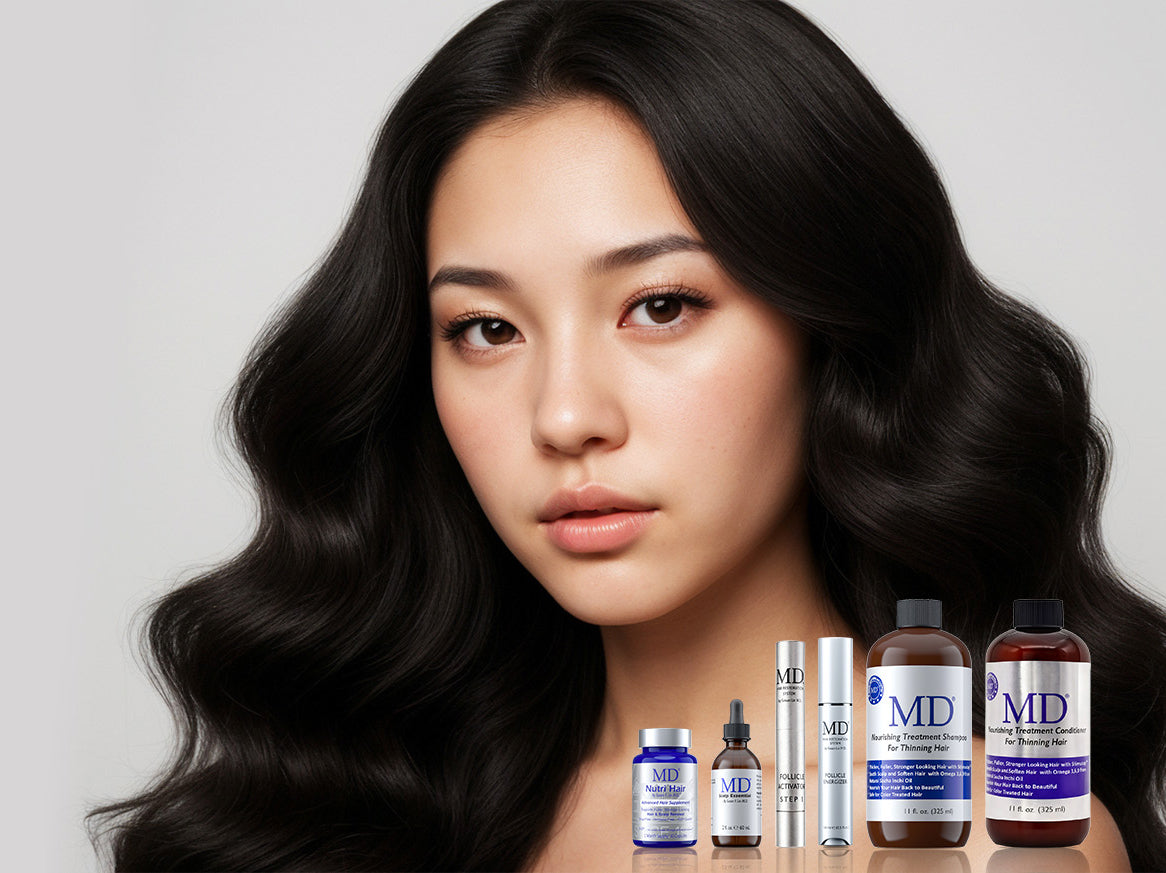
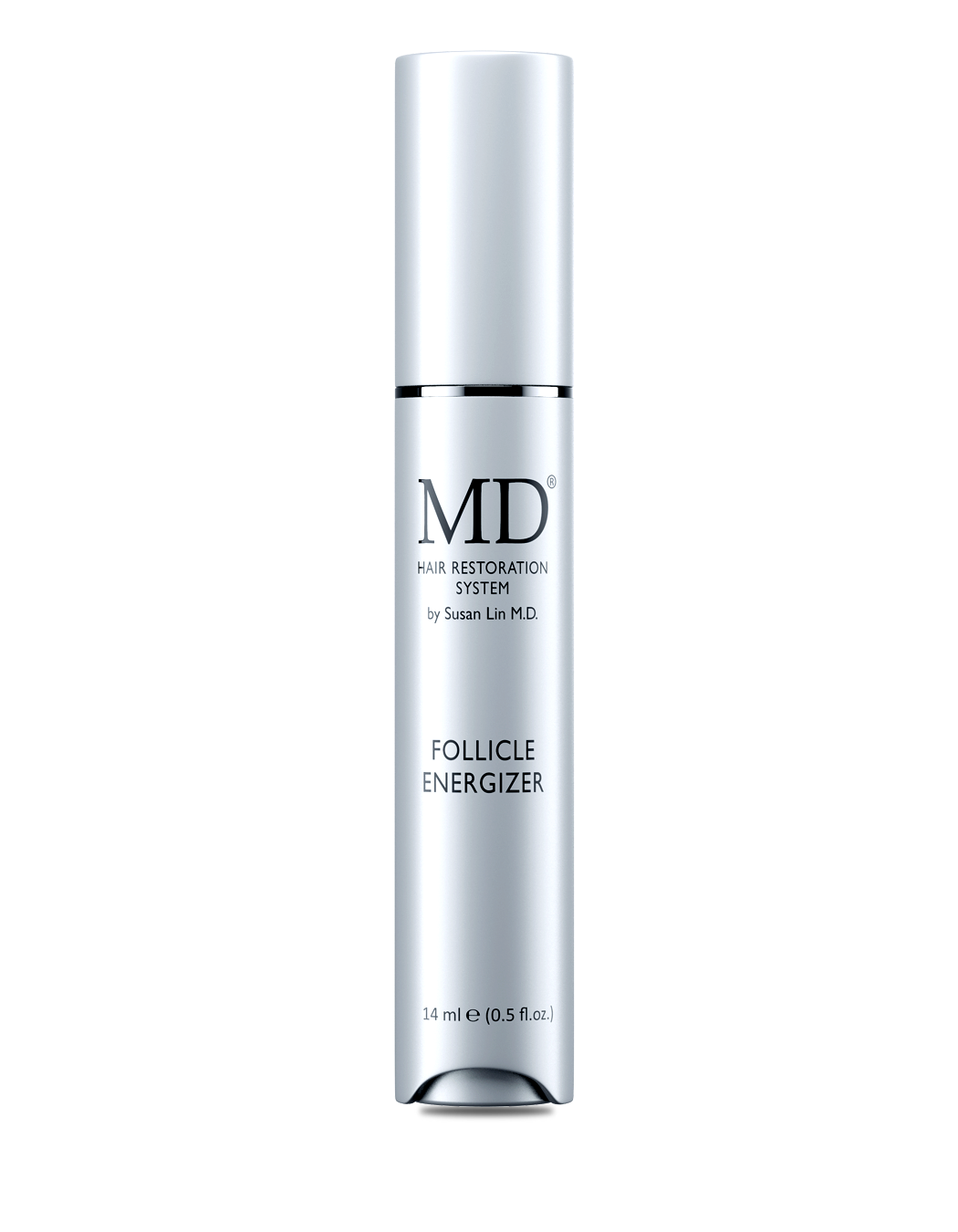
MD Hair™ — the physician-formulated hair care brand within the MD® family — was built around this conceptual framework from the start. The MD Hair™ Follicle Energizer is the product in the system that most directly embodies the cytokine-signaling approach. Its formulation is designed to deliver peptide and botanical actives that, in combination, aim to support the dermal-papilla-and-bulge environment described above.

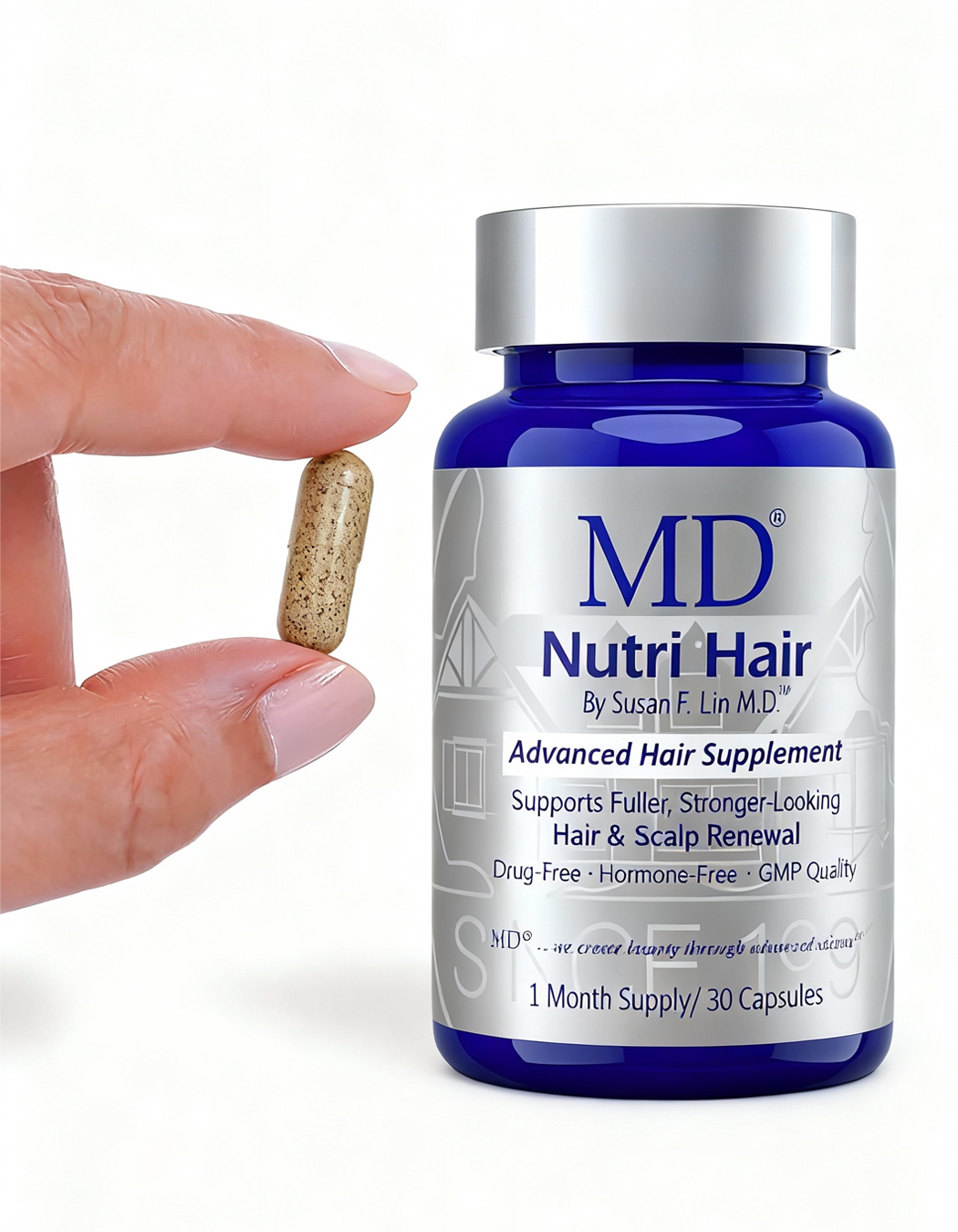
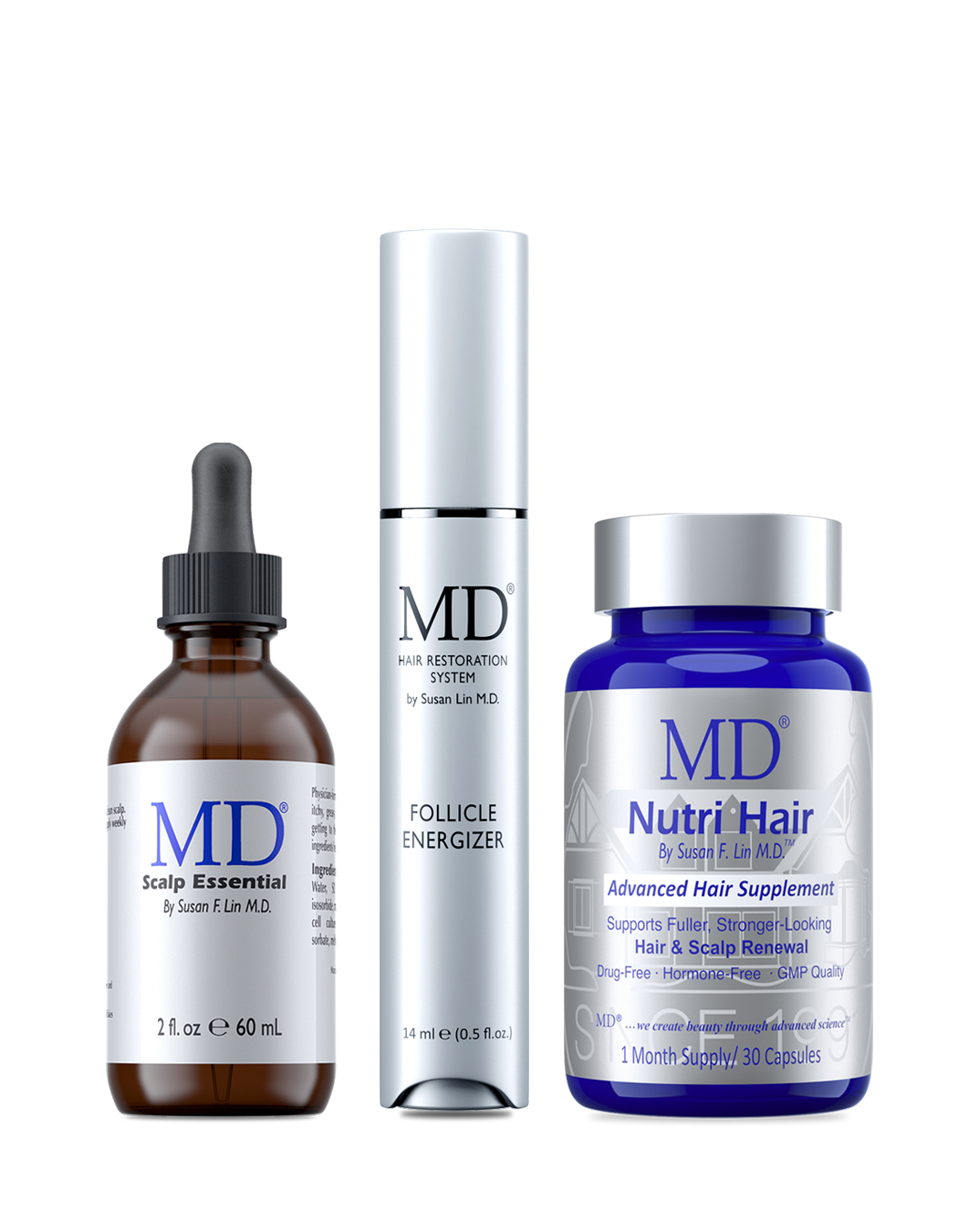
The broader system supports the same goal from multiple angles. MD Hair™ Nutri Hair contributes from the inside out, delivering the nutritional substrate the matrix cells need to build new hair shaft. MD Hair™ Scalp Essential respects the scalp microbiome that maintains the local signaling ecosystem. The MD Hair™ Revitalizing Treatment Shampoo and Conditioner are formulated to be follicle- and scalp-respectful complements that don’t disrupt the environment the other actives are trying to support.
The whole system operates under MD®, the federally registered USPTO trademark (Reg. No. 4,471,494, Class 3 cosmetics + Class 5 pharmaceuticals/dietary supplements). The hair-growth invention is protected by Dr. Lin’s international patent portfolio (US 20100249043; PCT/US2010/000843; WIPO WO 2010110863-A2; KR 20120012965-A; HK 1157672; CN 200810094338.2; CN 101283957).
What This Means for You, the User
If you have been frustrated by the hair-care market’s usual choice — a drug with side effects or a styling product that doesn’t address biology — the cytokine-signaling approach is a third path. It is honest about what it does and what it doesn’t do. It supports the follicle environment. It does not promise miracles. It works on the timescale of the hair growth cycle itself, which is months.
The same caveat I give every patient applies: hair changes that are sudden, severe, patchy, or accompanied by other symptoms warrant a medical evaluation, not a cosmetic conditioner. Cytokine-signaling care is for supporting baseline scalp and follicle health, not for diagnosing or treating disease.
Frequently Asked Questions
What are hair follicle stem cells and what do they do?
Hair follicle stem cells (HFSCs), also called bulge stem cells, are a small population of resident stem cells located in the bulge region of the outer root sheath of each hair follicle. They have three defining properties: self-renewal, multipotency (they can give rise to multiple cell types in the follicle), and quiescence (they spend most of their time in a resting state). When the right chemical signals arrive from the dermal papilla — primarily Wnt-pathway activators — the bulge stem cells exit quiescence, divide, and produce the matrix cells that build a new hair shaft. They are the regenerative engine of every hair cycle.
Can topical cosmetics really activate hair follicle stem cells?
Topical cosmetics do not directly “activate” stem cells in the way that gene therapy or regenerative medicine procedures might. What they can do is support the chemical environment around the follicle — the cytokine and growth-factor balance, the antioxidant status, the scalp microbiome — in ways that may nudge the activating/inhibiting balance in a favorable direction. The honest framing is that cytokine-signaling cosmetic products are environmental support, not direct regenerative therapy. The underlying biology is real, but the magnitude of effect is consistent with cosmetic, not pharmaceutical, classification.
What are growth-factor cytokines and how do they relate to hair?
Cytokines and growth factors are specific protein molecules that cells use to send chemical messages to each other. In hair biology, the key messengers include the FGF family (especially FGF-7 and FGF-10), IGF-1 (Insulin-like Growth Factor 1), VEGF (Vascular Endothelial Growth Factor), KGF (Keratinocyte Growth Factor), Wnt-pathway ligands (which activate the bulge stem cells), and BMPs (which counterbalance and maintain quiescence). The dermal papilla is the primary source of these signals. The balance between activating and inhibiting cytokines determines whether the follicle enters a new growth cycle. Modern cytokine-signaling cosmetic actives are designed to support a favorable balance.
Is the “stem cell” cosmetic approach the same as exosome therapy or PRP?
No. Exosome therapy and platelet-rich plasma (PRP) are in-office procedures that deliver biological materials directly to the scalp through injection or microneedling. They are medical procedures, not cosmetics, and they require a physician or licensed clinician. Topical cytokine-signaling cosmetics — like the MD Hair™ Follicle Energizer — are applied to the scalp at home as part of a daily routine and work through the environmental support mechanism described above. They are complementary categories addressing the same underlying biology at different levels of intensity.
How does MD Hair™ Follicle Energizer apply this science?
The MD Hair™ Follicle Energizer is a daily topical scalp serum formulated around the cytokine-signaling concept described in Dr. Susan Lin’s 2013 publication in The Link — The Voice of the American Hair Loss Council. It combines peptide signaling fragments, botanical bioactives, and supporting antioxidants in a formulation designed to support the dermal-papilla-and-bulge environment described above. It is part of the broader MD Hair™ system — which sits within the federally registered MD® trademark family (USPTO Reg. 4,471,494, Class 3 + Class 5) — and is sold at md-factor.com and at www.mdhair.com, the official MD Hair brand site.
How long until I see results from a cytokine-signaling approach?
The hair growth cycle is approximately 12–16 weeks long. A cytokine-signaling cosmetic affects the cycle by supporting the signaling environment over time; it does not bypass the cycle. Most users notice early scalp comfort and reduced shedding within 4–6 weeks. Visible density changes typically appear at 3–4 months. The full assessment window for any cycle-modulating approach is approximately 6 months of consistent daily use, because that is the timeframe over which a meaningful proportion of the follicle population will complete a cycle and reflect the new environment. Be skeptical of products promising dramatic results in weeks; the underlying biology does not support those timelines.
This article is for educational purposes only and does not constitute medical advice. If you are experiencing sudden, severe, patchy, or otherwise concerning hair loss, please consult a licensed physician or dermatologist for evaluation. Discussion of stem cell biology, cytokine signaling, and growth factor pathways reflects the published scientific literature; topical cosmetic conditioners, including MD Hair™ products, are not drugs and are not intended to diagnose, treat, cure, or prevent any disease.